



Post-Quantum Cryptography: The Security Challenge in the Quantum Era
What exactly is a quantum computer, and why does it matter to us?
Quantum computing is not science fiction, but a reality. Unlike classical bits (0 or 1), qubits are units that can exist in multiple states simultaneously (superposition) and interact with one another in a correlated manner (entanglement), enabling large-scale parallel computations.
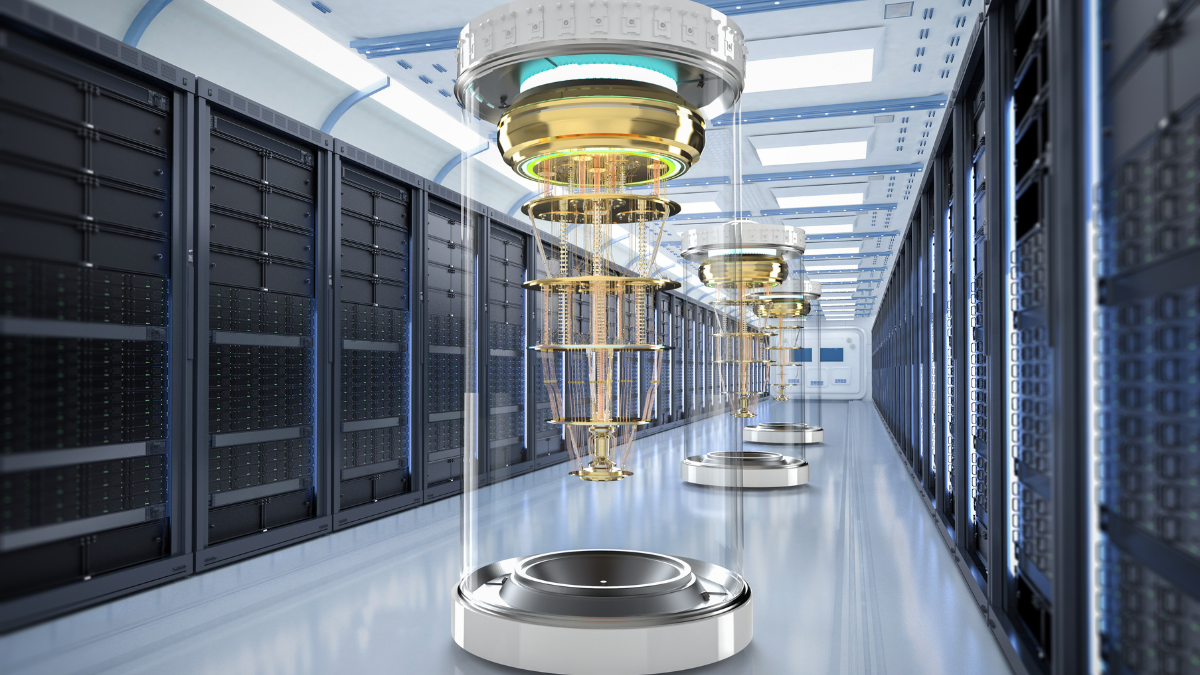
Today, quantum chips are built using superconducting circuits cooled to a few millikelvin. Qubits are created through Josephson junctions and are manipulated using microwaves in cryogenic environments. In the lab, researchers are also experimenting with topological qubits based on the mysterious Majorana particle.
Companies such as IBM, Google, and Microsoft, along with startups like Rigetti, IonQ, and PsiQuantum, are pushing in this direction, with devices ranging from a few dozen to hundreds of hyper-specialized qubits—devices that already hint at the power to come.
How powerful are quantum computers compared to today’s supercomputers?
The most advanced supercomputer today is Frontier (Oak Ridge National Laboratory), capable of over 1.2 exaFLOP/s (10¹⁸ operations per second). But a universal quantum computer, with just a few thousand logical qubits, will be able to solve certain problems in exponentially less time: tasks that are currently unsolvable would become quick to solve. With Shor’s algorithm Shor’s algorithmalgorithm, cracking RSA-2048 would take seconds instead of millennia. It’s a revolution on the horizon, and it’s about to surpass the current record held by supercomputers.
Real Risks: What Is Truly Vulnerable?
Future Attacks on Data Encrypted Today (“Harvest-now, Decrypt-later”)
An actor with access to encrypted data today could store it and decrypt it in the future as soon as a suitable quantum computer becomes available. The threat is real: today it’s mined, tomorrow it’s cracked.
Infrastructure at Risk: The Attack Surface of Quantum Computing
The danger is not some distant threat: much of today’s digital infrastructure—public, private, and decentralized—relies on cryptographic mechanisms that will be vulnerable once quantum computing becomes a reality. The attack surface is vast and affects every segment of our economy and our daily digital lives.
Traditional infrastructure: banks, public agencies, industry
Algorithms such as RSA, ECC (elliptic curves), and Diffie–Hellman are the cornerstones of modern cybersecurity. They are used every day in:
- TLS/SSL, for securing HTTPS communications
- Corporate VPNs, for secure remote connections
- Digital certificates, electronic signatures, certified email (PEC), and electronic identities
- SSH keys, for accessing servers
- PKI Infrastructure in Government, Industrial, and Military Systems
Using Shor’s algorithm, a sufficiently advanced quantum computer will be able to factor large integers and compute discrete logarithms, breaking 2048-bit RSA keys and elliptic curve cryptosystems such as P-256 or secp256k1 in just a few hours.
Implications:
- Forgery of digital signatures on legal documents or electronic contracts.
- It could intercept and decrypt encrypted communications or impersonate a legitimate user.
- In industrial or SCADA (Supervisory Control and Data Acquisition) contexts, this would mean unauthorized remote control of critical devices.
CeFi vs. DeFi Finance: Two Different Vulnerabilities, Same Risk
CeFi (Centralized Finance)
Banks, financial institutions, and insurance companies use centralized protocols that employ TLS, digital signatures, two-factor authentication systems, and PKI infrastructure.
Pros: They can centrally update software and infrastructure.
Cons: Update cycles are long and subject to regulations, audits, backward compatibility, and high costs.
A successful attack on a CeFi system could compromise:
- Digitally signed transactions,
- Automated banking contracts ,
- Access to restricted portals.
DeFi (Decentralized Finance)
Decentralized finance is based on smart contracts, wallets, and public blockchains. Most wallets use ECDSA on secp256k1 (Bitcoin, Ethereum) or similar curves.
The biggest risk is that public keys can be derived from digital signatures (as is the case with ECDSA), allowing a quantum attacker to calculate the private key and empty the wallet.
In addition, updating an ecosystem such as Ethereum or Bitcoin requires:
- Coordination between nodes,
- Community consensus ,
- Compatibility with millions of existing smart contracts .
This makes the transition to post-quantum schemes difficult and time-consuming.
Personal and Institutional Wallets and Digital Currencies
Personal wallets are the vault for every crypto user. If a malicious actor were to calculate the private key from a signature on the blockchain (as is the case with ECDSA wallets), they could transfer funds without authorization, and those funds would be irretrievable.
The situation is even more critical when it comes to institutional or government wallets, which could hold:
- Government treasuries or central banks,
- Digital currency reserves (CBDC),
- Login credentials for public services.
A successful attack would mean fraud, financial destabilization, or state-sponsored attacks.
Blockchain Mining and Security (Proof of Work)
Hash algorithms such as SHA-256 (Bitcoin) and Keccak (Ethereum) are considered partially resistant to quantum computation. They cannot be broken directly like RSA, but their security is reduced quadratically by Grover’s algorithm, which cuts the time required to find collisions or pre-images in half.
Possible effects :
- Greater mining efficiency for those who own quantum computers, disrupting the decentralized balance.
- Facilitated 51% attacks, in which an attacker controls the majority of hash power and can manipulate transactions or reorder blocks.
This jeopardizes the immutability of and trust in public ledgers.
Artificial Intelligence: Classical vs. Quantum
Traditional artificial intelligence—the kind that powers large language models (LLMs) today—relies on GPU-intensive architectures. Graphics processing units (GPUs) are ideal for performing the type of parallel matrix computations required by deep neural networks.
However, even the most powerful GPUs have physical and computational limitations:
- Deep learning scales linearly with increases in data and architectural complexity.
- Optimizing very large models takes days or weeks of computation.
- Managing the hyper-parametric space is costly and often imprecise.
Quantum artificial intelligence (Quantum AI) arises from the integration of quantum algorithms into the machine learning lifecycle. Some scenarios already under study include:
- Quantum-enhanced data encoding: encoding complex datasets in extremely high-dimensional Hilbert spaces, with the ability to represent hidden correlations more compactly.
- Quantum kernel methods: nonlinear classification techniques enhanced by quantum kernel functions that overcome the limitations of the classical Support Vector Machine (SVM).
- Quantum annealing: for optimizing complex functions; useful in reinforcement learning and for designing neural network architectures.
Variational Quantum Circuits (VQC): parameterizable quantum neural networks that can learn patterns with lower computational costs.
A Real Threat: Quantum AI as a Vehicle for Attack
A quantum system capable of learning from encrypted datasets (e.g., homomorphic encryption), bypass classical AI defenses (e.g., deepfake detection, spam filters, anomaly detection), and generate payloads and targeted attacks more efficiently could become a powerful offensive weapon in the hands of government actors or cybercriminals. Furthermore, models of quantum adversarial learning are being proposed, in which quantum AIs design imperceptible yet highly effective perturbations to deceive classical models in contexts such as surveillance, biometric identification, or autonomous driving.
Quantum AI for Defense, Too
The upside is that Quantum AI can become an ally in security: identifying zero-day vulnerabilities with more accurate predictive models, dynamically optimizing security policies across hybrid infrastructures, and advanced detection of complex attacks in multi-layer networks.
PQC: Algorithms Resistant to Quantum Attacks
NIST has selected the best algorithms in the KEM (key exchange) and digital signature categories that are secure even against quantum computers.
CRYSTALS–Kyber
- Latex-based, secure key exchange. Efficient and compact, already integrable with TLS.
CRYSTALS—Dilithium
- Latex-based digital signature. Fast, robust, and suitable for embedded systems or blockchain.
FALCON
- Lattice-based digital signature with a smaller output size than Dilithium.
SPHINCS+
- Hash-based digital signature that does not rely on lattices. Very robust, but more computationally intensive.
These algorithms represent the most promising solutions for defending against a large-scale quantum attack.
How to Proceed: An Operational Roadmap for Businesses and Governments
1. Audit and Inventory
Identify all the cryptographic algorithms in use: RSA, ECC, certificates, VPN, TLS, SSH…
2. Crypto-agility and Hybrid Networks
Adopt hybrid protocols: classical algorithms + PQC, such as hybrid TLS and OpenSSH with mixed key exchange.
3. Plan the migration
Adopt the NIST standard and overhaul PKI infrastructure, signature systems, and key management systems.
4. Institutional Collaboration
Public-private governance, training, R&D, and centers of expertise to promote PQC skills.
5. Immediate Prevention
Encrypt sensitive data immediately using quantum-resistant algorithms to prevent future decryption.
Conclusion: Why Take Action Today?
Quantum computing is just around the corner. Post-quantum cryptography is the only reliable defense against the future ability to break current cryptographic systems. Investing now in audits, hybrid solutions, training, and migration will ensure that banks, institutions, blockchains, AI, and citizens remain protected even in the new quantum paradigm.
Useful resources: