




From Edge AI to Sovereign Inference: The True Meaning of the Breakthrough Announced at NVIDIA GTC 2026
In June 2025, we described the evolution of edge computing as an inevitable transition: from content distribution to computing distribution, and finally to distributed inference.
It was no longer just a matter of bringing data closer to users, but of bringing intelligence closer to the data. That analysis already clearly pointed in one direction: the edge would become a point of decision-making, no longer merely a node for optimization.
A few months later, Jensen Huang’s keynote at NVIDIA GTC 2026 gave that insight an industrial form, making it explicit and strategic. The concept introduced— “inference inflection” —marks the transition from training-centric AI to continuous execution-centric AI. This is not merely a semantic shift. It is a redefinition of the very role of artificial intelligence in economic and production systems.
Add the title text here: AI Factory: When Inference Becomes Production
If training represents the building of capacity, inference represents its real, continuous, and pervasive application. It is through inference that decisions, automations, interactions, and economic value are generated.
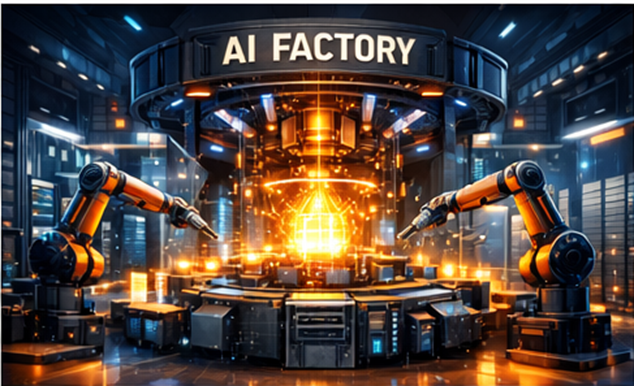
This is why Huang has described data centers no longer as IT infrastructure, but as “AI factories”: systems that transform energy into tokens, and tokens into operational output. In this vision, artificial intelligence ceases to be a tool and becomes a productive infrastructure.
The data center as an AI factory: continuous inference is treated as production capacity.
NVIDIA’s strategy perfectly reflects this transition. It is no longer about developing increasingly powerful accelerators, but about building a complete ecosystem for inference.
New architectures such as Vera Rubin and Rubin Ultra, integrated platforms that combine GPUs, CPUs, networking, and storage, advancements in data movement and memory such as BlueField-4, and the increasingly central role of orchestration software—such as Dynamo—clearly demonstrate that value is shifting from the individual chip to the overall system.
Inference is no longer an isolated operation, but a continuous process that requires coordination among distributed resources, flow optimization, and context management.
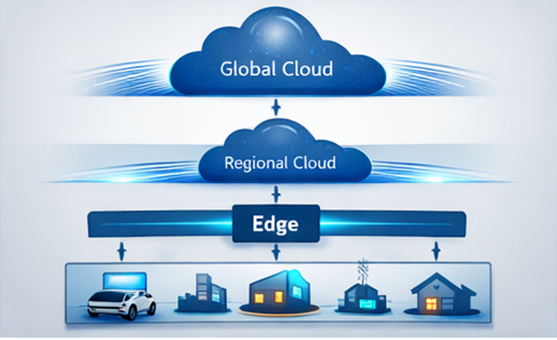
Distributed Architecture: Global Cloud, Regional Clouds, Edge, and Devices
And it is precisely this distributed nature that radically changes the picture. Inference cannot be centralized—not by choice, but out of necessity.
Constraints related to latency, cost, energy efficiency, and—above all—context make a multi-tiered distribution inevitable: a global cloud for the most complex models and orchestration, regional clouds for regulatory and governance requirements, the edge for real-time processing, and local devices for maximum proximity to the data.
The Edge as a Decision-Making Point
It is in this context that the “edge” takes on a completely new meaning. In our 2025 article, the edge was described as an evolution of distributed infrastructure. Today, we can say that it has become something more: a point where decisions are made.
It does more than just improve performance; it enables the execution of intelligent logic close to the operational context. In factories, networks, devices, and healthcare systems, the edge no longer distributes content but rather decision-making capabilities.
Edge AI enables local decision-making in industrial, healthcare, and infrastructure settings.
“We’re not just entering the age of AI. We’re entering the age of environmental inference: a distributed, continuous, local, or edge intelligence embedded in devices, networks, machines, and processes.”
This has a consequence that goes beyond technology. When inference becomes continuous and pervasive, artificial intelligence enters critical processes—those that determine operability, efficiency, and security.
And at that point, a question arises that is no longer technical but strategic: what happens when this decision-making capability depends on external infrastructure?
The current model based on centralized AI services—offered by large global providers—introduces a new form of dependency. It is no longer just a matter of outsourcing a service, but of delegating part of one’s operational capacity.
Data is sent off-site, the context is processed elsewhere, and decisions are generated on infrastructure that is not under direct control. As long as AI is ancillary, this model is sustainable. But when it becomes an integral part of processes, the nature of the risk changes.
An outage, a slowdown, or a change in policies or access conditions no longer has a marginal impact. They can compromise operational continuity. They can block decision-making flows. They can generate direct economic effects. In this sense, dependence on centralized AI services constitutes a new systemic risk.

Sovereign Inference: Control, Resilience, Autonomy
This is where the issue of sovereignty really comes to the fore. In recent years, there has been much discussion about data sovereignty, but in the age of inference, this perspective is no longer sufficient. It is not enough to know where the data resides. It is necessary to know where it is interpreted, where it is transformed into decisions. Because it is through inference that real value is generated, and that is where control is concentrated.
Talking about sovereign inference therefore means talking about control over three fundamental dimensions: data, decision-making, and resilience. It means being able to run artificial intelligence autonomously, without relying entirely on external infrastructure. It means being able to ensure operational continuity even when the network or services are disrupted. Ultimately, it means maintaining control over one’s own processes.

In this context, edge AI is not simply an architectural evolution, but a structural response to a need for control. Bringing inference closer to the data means reducing exposure, increasing resilience, and preserving autonomy. It is not just a matter of latency or efficiency. It is a matter of operational independence.
The transition we are experiencing can be clearly summarized as follows: from the distribution of content to the distribution of intelligence. And distributing intelligence means distributing power—not in an abstract sense, but in a concrete one: who decides, where decisions are made, under what constraints, and with what degree of autonomy.
This is why the transformation currently underway does not concern only system architects or IT managers. It concerns those who govern businesses, infrastructure, and institutions. Because in the age of inference, artificial intelligence is no longer merely a decision-support tool. It is an integral part of the decision-making process itself.
The question that inevitably arises, therefore, is: Is it sustainable to build critical systems whose decision-making capabilities depend on external, centralized, and uncontrollable infrastructures?
GTC 2026 marks the beginning of a new phase—not because of the technologies presented, but rather because of the awareness it brings. Artificial intelligence cannot remain confined to global data centers. It must be distributed, orchestrated, but also controlled. It must be able to operate autonomously, resiliently, and contextually.
The future of AI will not be defined solely by the power of the models, but by the ability to bring them where they’re truly needed: close to the data, the processes, and the people. And at stake in this transition is more than just technological evolution. What’s at stake is control over the operational intelligence of the systems upon which we will build the next phase of the digital economy.